PHP2Shell: Are DevOps and DevSecOps Ready for the AI-Driven Security Era?
We've automated software delivery. Now AI-assisted vulnerability discovery is challenging how quickly we can identify, secure, and govern our production environments.
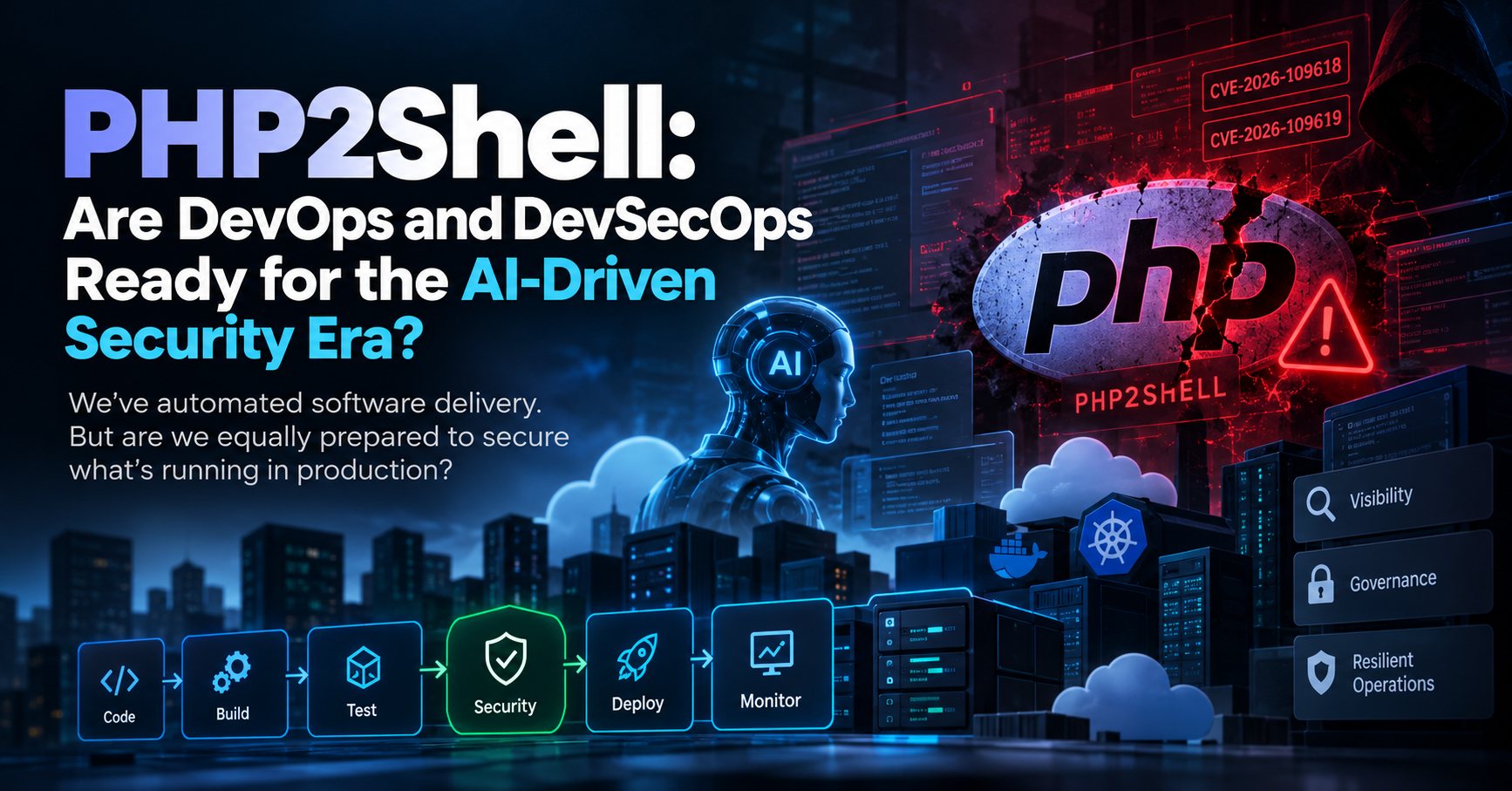
The recent PHP2Shell vulnerability disclosure caught my attention, not just because of its severity, but because of what it signals for the future of cybersecurity.
On October 21, 2026, two critical PHP vulnerabilities, CVE-2026-109618 and CVE-2026-109619, were disclosed, both carrying a CVSS 4.0 score of 9.2.
What's particularly interesting is how AI-assisted security research helped uncover and investigate weaknesses that had existed for years.
It raises an important question:
If AI can help discover complex vulnerabilities faster, are our security operations ready to respond at the same pace?
🚨 The Real DevOps Challenge
We've made remarkable progress in CI/CD, Infrastructure as Code, Kubernetes, cloud automation, and observability.
We can deploy applications in minutes and monitor infrastructure in real time.
Yet when a critical CVE is announced, many teams still struggle with fundamental questions:
- 🔍 Which production workloads are affected?
- 📦 Are vulnerable dependencies hidden inside container images or legacy applications?
- 🛠️ Can we identify, patch, and validate affected systems without disrupting production?
A healthy application doesn't necessarily mean a secure application.
A green pipeline tells us the deployment succeeded. It doesn't guarantee the software is still secure.
This is where DevSecOps needs to evolve beyond build-time scanning toward continuous runtime visibility and vulnerability management.
🤖 AI Is Changing the Security Landscape
AI-assisted research is accelerating vulnerability discovery, code analysis, and security investigations.
That's a significant advantage for defenders, but similar capabilities could also help attackers investigate weaknesses more efficiently.
As AI agents become part of DevOps workflows, another challenge emerges: governance.
An AI agent might identify a vulnerable runtime, propose a fix, and prepare a deployment.
But should it have unrestricted access to execute production changes?
Not necessarily.
AI should accelerate security decisions, not bypass engineering controls.
Least-privilege access, approval workflows, audit trails, and verified remediation must remain central to AI-driven operations.
🛡️ Where DevSecOps Needs to Go Next
I believe the next evolution of DevSecOps is about connecting three critical capabilities:
🔎 1. Visibility
Know exactly what's running across infrastructure, containers, and applications.
🧠 2. Intelligence
Use AI to accelerate vulnerability detection, impact analysis, and remediation planning.
🔐 3. Governance
Ensure automated actions follow security policies, access controls, and approval processes.
The real opportunity isn't adding another dashboard or AI tool. It's connecting existing systems so teams can move from vulnerability discovery to verified remediation faster.
💡 Final Thoughts
PHP2Shell is more than another critical vulnerability.
It's a reminder that while we've become incredibly efficient at delivering software, securing it continuously remains a challenge.
AI will continue to accelerate both software development and security research. Our operational practices need to evolve alongside it.
DevOps taught us to deliver faster. DevSecOps taught us to integrate security. AI is now challenging us to respond faster, without losing control.
And that leaves us with an important question:
We've automated how quickly we deploy software. Have we done enough to automate how quickly we secure it?
📚 References
Tags: DevOps DevSecOps Cybersecurity AISecurity CloudSecurity
About the author
🚀 DevOps Engineer | 🌐 Multi-Cloud Certified (AWS, Azure, GCP) | 🐳 Kubernetes & Docker | ⚙️ CI/CD Automation (Jenkins, GitLab, GitHub Actions,Azure DevOps) | 🔧 Infrastructure Automation (Terraform,Ansible) | Observability Stack(Promethus,Grafana,EFK) | Building Scalable, Resilient Infrastructure | | 👥 Connect on LinkedIn!
Comments
Join the discussionNo comments yet. Be the first to comment.